

Why it's important to us that you check the anchor baseplate rigidity
Modern fixtures allow structures to transfer heavy loads, and these safety-relevant joints must be designed with precision. A widespread and consolidated approach when it comes to calculating a steel-to-concrete connection assumes that the anchor baseplate remains flat and elastic under the influence of forces. Most likely, this is what you considered in all your previous post-installed anchor designs. As is the case with any other assumptions, this must be confirmed.
This post is inspired by a comprehensive technical dissertation on this subject published in Stahlbau (you can find the link to the reprint translation of the original German report at the very end of this page):
Fitz, M. , Appl, J. and Geibig, O. (2018), Wirklichkeitsnahe und vollständige Bemessung von Ankerplatten einschließlich der Befestigungsmittel – neue Bemessungssoftware auf Basis wirklichkeitsnaher Annahmen. Stahlbau, 87: 1179–1186. doi:10.1002/stab.201800036.
What does rigid anchor baseplate mean?
In theoretical rigid anchor baseplate behavior, the load distribution is simplified by assuming that the plate itself does not deform analogously to Euler-Bernoulli’s beam theory. Strains are distributed linearly through the cross-section of the anchor baseplate.
Under this hypothesis, the load distribution under the plate and the anchor are determined as illustrated in the next figure.
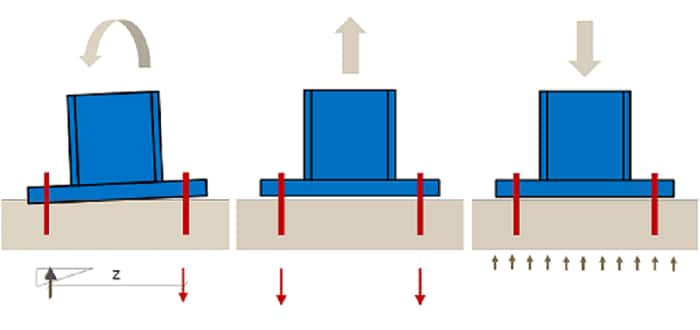
Reaction forces in the fixture due to a bending moment,
tension and compression load in a rigid anchor baseplate
This simplified beam theory is well accepted by civil engineers, mainly because it can prove that the cross-section does not deform for beam elements with small cross-section dimensions in relation to the longitudinal extension. This is not always the case for a steel anchor baseplate, where the longitudinal dimension is represented by the plate thickness.
Let’s further outline the problem by looking at the three main consequences of incorrectly applying the rigid theory for an insufficiently stiff anchor baseplate.
Consequence 1: Higher loads on anchors and higher stress on concrete
If, in contrast with the assumption, a flexible anchor baseplate is used, this may lead to a reduction in the lever arm of the internal forces and thus to higher loads on the fixture, depending on the rigidity. The plate corners can become compressed against the concrete, inducing additional prying forces which, in turn, lead to an increase in the tensile force in the anchors.
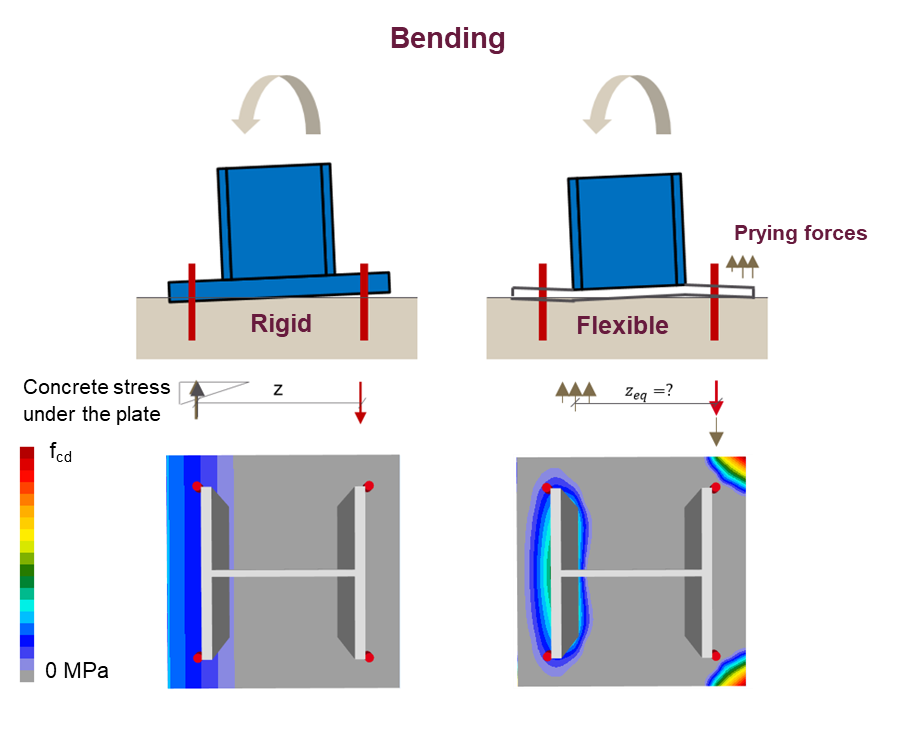
The reduction of the level arm in a flexible anchor baseplate
results in higher tension load in the anchors
and prying force on the concrete
These prying forces can also occur with larger anchor baseplate protrusions, flexible anchor baseplates and predominantly tensile loads, where the deformation of the loaded anchor baseplate leads to significant overloading and premature failure of an anchor within a group.
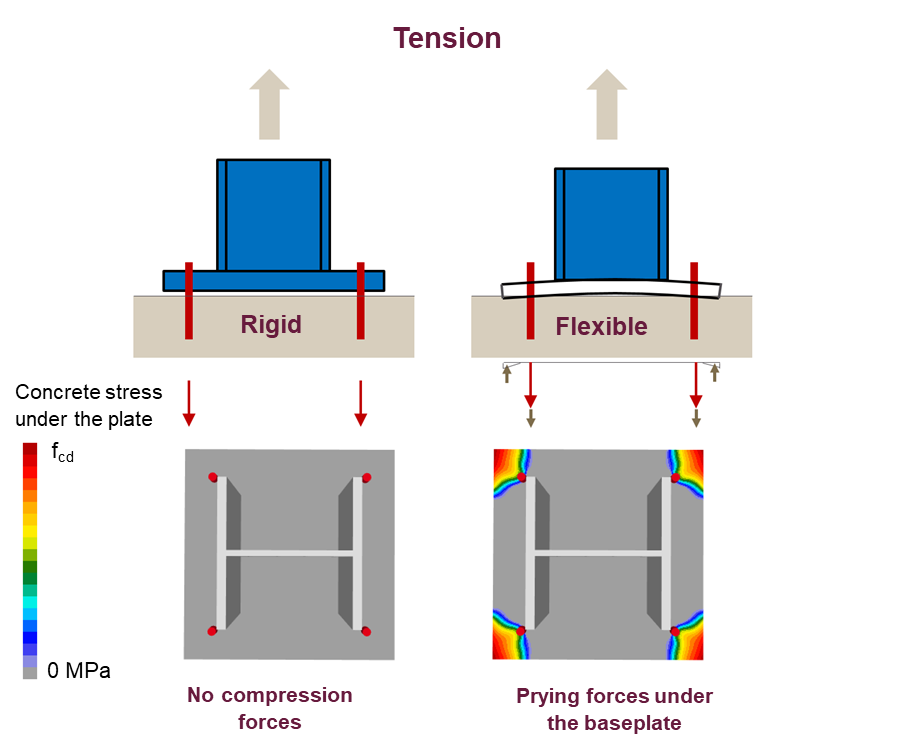
In a tensioned flexible or rigid baseplateanchor baseplate, the Pryingprying forces
are equilibrated by higher tension load in the anchors
Also, in the case of a non-stiff plate under predominantly compression load, the stress distribution on the concrete under the plate might result in higher values than those calculated where rigid anchor baseplate behavior design is assumed.
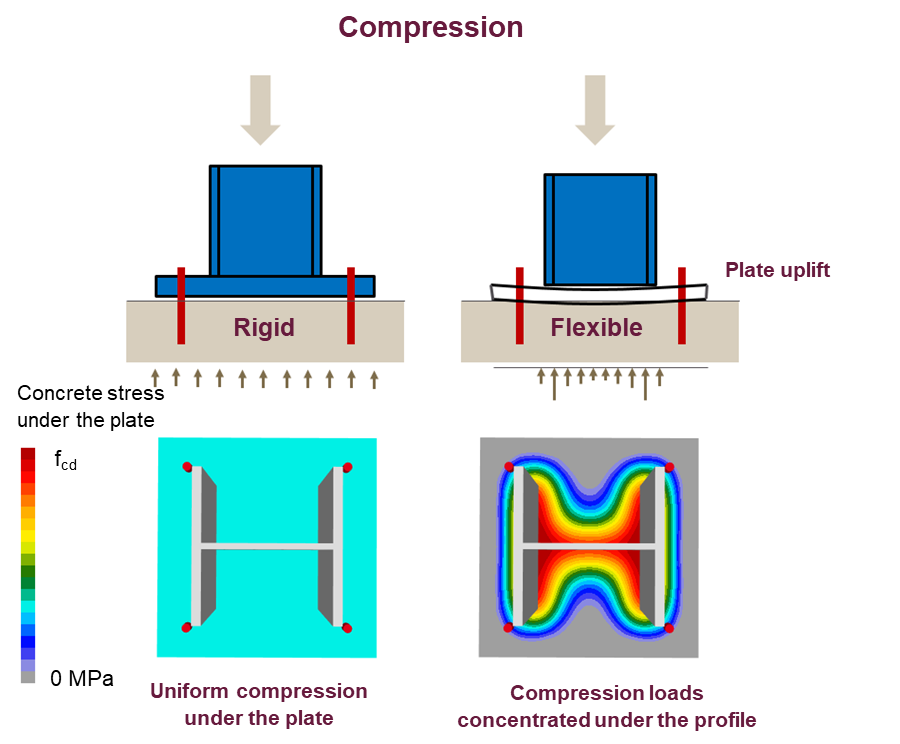
In a compressed flexible or rigid anchor baseplate,
the stress distribution results in higher
concentrated loads on the concrete base
Consequence 2: Non-compliance with anchor design codes
In most international standards such as Eurocodes 2 and ACI 318, resistance equations for a group of anchors are based on rigid anchor baseplate assumptions only. Therefore, by using the formulas provided by these guidelines in the case of flexible anchor baseplates, the anchor calculation can lead to inaccurate results. This is why the disclaimer for checking the rigidity of the plate is clearly stated in the anchor calculation report with the PROFIS Engineering software.
Consequence 3: Underestimated deflection in SLS
Non-rigid anchor baseplates tend to exhibit greater deformation than rigid plates. For a cantilever beam, a non-rigid anchor baseplate will result in greater displacement as there is more rotation in the anchor baseplate. As an engineer, you should consider this in the SLS assessment, especially in cantilever and self-standing applications.
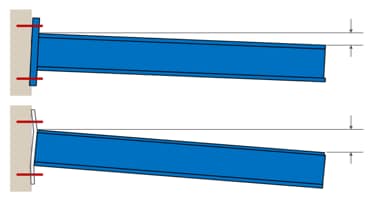
Displacement of the cantilever beam in the case of rigid and non-rigid anchor baseplates
The solution
It should now be clear that assessing the plate rigidity is critical in terms of application safety. Despite this, no clear rules are available in literature on how to properly validate this requirement. Therefore, this step is generally omitted or qualitative judgements on the plate geometry (e.g. ‘thick-enough feeling’) and stiffeners arrangement are only considered.
It's quite simple, FEM analysis is the state of the art for a realistic assessment of anchor baseplate rigidity and for ensuring an adequate design of the full connection.
In the future, with the Hilti PROFIS Engineering Suite/base it will be possible to calculate plates taking into account flexibility and the real behavior of plate module components. It provides a precise verification of all the components of a joint, combining the component method commonly used in steel construction with a powerful CBFEM finite element calculation.
We promise to elaborate further on this in future articles, but in the meantime, more information on the technical case and solutions can be found in the above-mentioned technical publication.
Share your thoughts or questions, or request of information about the brand-new upcoming PROFIS Engineering software, by leaving a comment.