
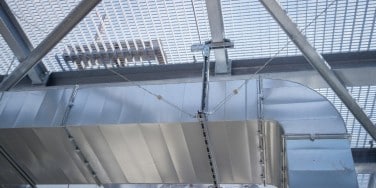
Innovative solutions for non-structural seismic installation applications
Among non-structural elements, installation support components can be one of a building’s main vulnerabilities during a seismic event. If not designed correctly, their repair cost can exceed the cost of retrofitting the structural elements.
Hilti has invested in research and product development to upgrade seismic resistant solutions for non-structural elements. These include technical installations in public and commercial buildings (e.g. hospitals, shopping malls, hotels, schools) and solutions for Energy & Industry (pharma, data centers, automotive and power). By working to offer you more productivity, better safety and additional cost efficiency, constant innovation ensures Hilti remains your leading partner for seismic solutions.
The Hilti Seismic Bracing System is suitable for light-to-heavy piping, ventilation and electrical systems. It employs three different methods of bracing: a wire bracing system, a threaded rod bracing system and a channel bracing System.
Bracing with wire, rod and channel systems
The Hilti Seismic Bracing System uses seismic hinges, such as the newly developed MTS-AP, that deliver on average a 50% increase in productivity.
They do this by improving accessibility, making it easier to remove nuts, to fasten the hinge with only one screw and adjust the rod freely through the hinge.
Better accessibility also makes it possible to use power tools for fastening, further improving productivity.
As part of the new offering, the Hilti Seismic Bracing System also allows you to retrofit post-installed applications using the newly developed MTS-HR.
This new seismic hinge offers more construction flexibility because it is compatible with both wire and threaded rod bracings,
making it a good option for existing installations that need to be retrofitted with a seismic resistant solution.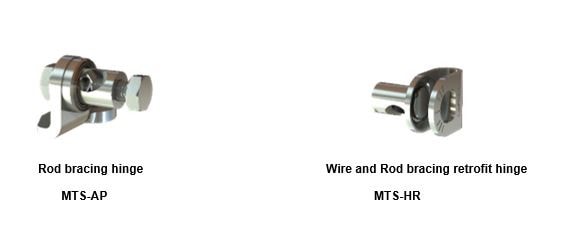
The Hilti Seismic Bracing System also offers added convenience, thanks to its compatibility with the Hilti MT and MW modular systems.

Ventilation seismic bracing support, combining MTS and MW systems
Hilti seismic hardware solutions are supported by software and engineering services. Hilti engineers help provide seismic design solutions based on the state-of-the-art standards and in compliance with building regulations (e.g. Eurocode 8, NTC 2018).
The dimensioning of a support can be carried out by means of an equivalent static check, considering an applied horizontal force (Fa) reported in NTC document:

Regarding the behavior factor qa, ductile systems can dissipate energy. For such systems, the seismic force can be reduced via the qa within the equation for Fa. For structures, in order to use a behavior factor of qa > 1.0 at the ultimate limit state, the energy dissipation capacity must be demonstrated and quantified. This includes high analysis or testing efforts. For some groups of non-structural elements, EN 1998-1:2004 chapter 4.3.5.4 sets out maximum values for the qa. Installation supports are not explicitly mentioned in this chapter. However, the general logic is if ductile behavior can be expected for a certain group of non-structural elements, the qa = 2.0 is linked with it.
“Anchorage elements for false (suspended) ceilings and light fixtures” are stated in this second group of elements. They are similar to installation support elements.
In EN 1992-4:2018 Table C.2, qa values for non-structural elements are stated. The categories
- “Computer access floors, electrical and communication equipment” (line 9);
- “High pressure piping, fire suppression piping” (line 13); and
- “Fluid piping for non-hazardous materials” (line 14)
are all related to qa = 2.0.
The general application of qa = 2.0 for the seismic design of Hilti installation systems is recommended, based on the above-mentioned sections from Eurocodes. Only for hazardous material storage and hazardous fluid piping should qa = 1.0 be used.
Regarding the seismic action coefficient (Sa), part of the horizontal force Fa is calculated with the following formula according to Eurocode 8:
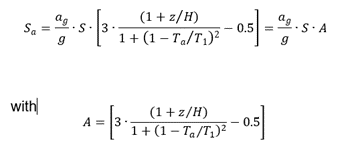
The fundamental vibration period Ta is a function of mass and stiffness of the non-structural element. Generally, the physical following formula applies also for installation systems:
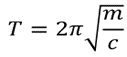
Our engineers perform this calculation with newly developed Hilti Software, allowing fully automatic assessment of the fundamental period of our modular support system.
Without detailed analysis, Ta/T1 = 1 can always be conservatively assumed.
The amplification factor A can vary widely between following values:
• stiff non-structural element (Ta/T1 ≅ 0) at foundation level of the building (z/H ≅ 0): A = 1.0
• non-structural element in resonance with building (Ta/T1 = 1) on the roof of the building (z/H ≅ 1): A = 5.5
For clarification and further details, you can ask our engineers a question directly using the Ask HILTI!